Speaking guides
TOEFL Speaking 2026 Listen and Repeat Task
TOEFL Speaking Listen and Repeat Task
Hello dear test-takers! Nutty the Squirrel here, ready to guide you through the TOEFL Speaking Task 1!
The first task in TOEFL Speaking 2026 is called Listen and Repeat. In this section, you will hear seven sentences connected to the same situation, and your job is to repeat each one clearly and naturally.
Grab a comfy branch, and I’ll walk you through everything clearly and smoothly.
Ready to stash away some knowledge? Let’s go!
What Task 1 Looks Like
Before the audio begins, you will see an image and some short directions. These directions help explain the situation shown in the picture. For example, the scene might involve a campus tour, instructions in a science lab, or a step-by-step process at a university building. A simple image will stay on the screen to support the topic while you listen.
You are working a part-time job at a grocery store near campus. You are being trained to assist customers. Listen to your trainer and repeat what he says. Repeat only once.
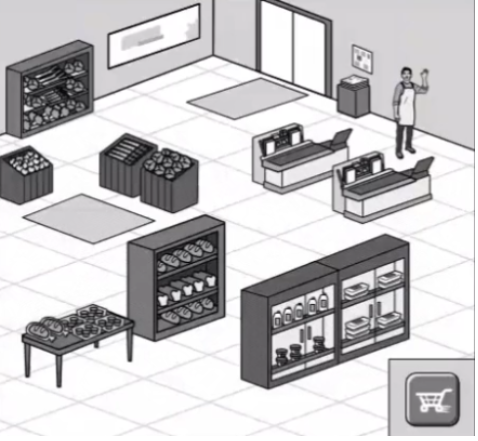
Each sentence is played one at a time. After each sentence finishes, you will hear a beep that signals your response time. Depending on the sentence, you will have between 8 and 12 seconds to answer.
The response times for the 7 sentences are:
- Sentence 1 → 8 seconds
- Sentence 2 → 8 seconds
- Sentence 3 → 10 seconds
- Sentence 4 → 10 seconds
- Sentence 5 → 10 seconds
- Sentence 6 → 12 seconds
- Sentence 7 → 12 seconds
If you speak at a natural pace, you will usually finish before the timer ends, so simply wait calmly until the next sentence begins.
Question: Should I focus more on speed or accuracy?
Answer: Both are important, but accuracy matters more. Try to speak clearly and naturally without rushing or thinking too much about every word.
The sentences do not all have the same difficulty level. The task becomes gradually more difficult as you continue through the 7 sentences:
- Sentences 1–2 are short and simple.
They usually contain about 9–11 syllables. - Sentences 3–5 are medium difficulty.
They are longer and include more important content words, usually around 14–16 syllables. - Sentences 6–7 are the most difficult.
These sentences often contain complex clauses, heavier information, and more challenging stress patterns. They usually have around 19–23 syllables.
Here are some helpful ways to prepare:
Practice Often
This is a skill you can train. The more practice sets you complete, the better your listening memory and speaking control will become.
Focus on the First Five Sentences
Since all sentences are scored individually, strong performance on the easier and medium-level items can raise your overall score nicely.
Break Sentences into Chunks
Instead of remembering many separate words, group the sentence into logical parts.
For example:
“Upstairs, the medium room // has laptops you can borrow.”
Chunking makes sentences much easier for your brain to store in its little squirrel paws.
Common Mistakes
In “listen and repeat” practice, the goal is simple: repeat exactly what you hear.
Short sentences are usually easy. But longer sentences can be harder to remember. Sometimes a few words quietly run away like tiny squirrels in the park. 🌰
When you practice, try to notice:
- which words you forget
- which sounds you confuse
- which mistakes happen again and again
If you notice your patterns, your listening will improve much faster.
Here are the most common mistakes learners make:
1. Forgetting letters at the end of words
Small endings like -s are very important in English.
2. Saying a different word because it feels familiar
Sometimes your brain guesses the word before you fully hear it.
3. Mixing up similar sounds
Some English words sound very close to each other.
4. Forgetting small grammar words
Words like the, a, and an may be small, but they are important.
5. Adding extra words
If you do not hear clearly, you may add words that were not in the sentence.
6. Changing the form of a word
This happens when the grammar changes by mistake.
7. Putting words in the wrong order
Sometimes the words are correct, but the order is wrong.
8. Using “um” or repeating words
Too many fillers can make your speech unclear.
9. Speaking too fast or too slowly
Good speaking has a natural rhythm.
10. Forgetting part of the sentence
Long sentences can be difficult to remember.
Practice
Daily Practice Plan
Try this easy daily routine:
- Find short audio clips with clear English speakers, such as podcast introductions, news clips, or YouTube videos.
- Play one sentence, pause the audio, and repeat the sentence exactly without reading a transcript.
- Record yourself and compare your version with the original speaker.
- Focus first on the most important content words — nouns, verbs, and adjectives usually carry the most scoring power.
- Slowly increase the sentence length over time, starting with short 4-word phrases and building up to full 15-word sentences after a few weeks of practice.
Listen and Repeat Checklist
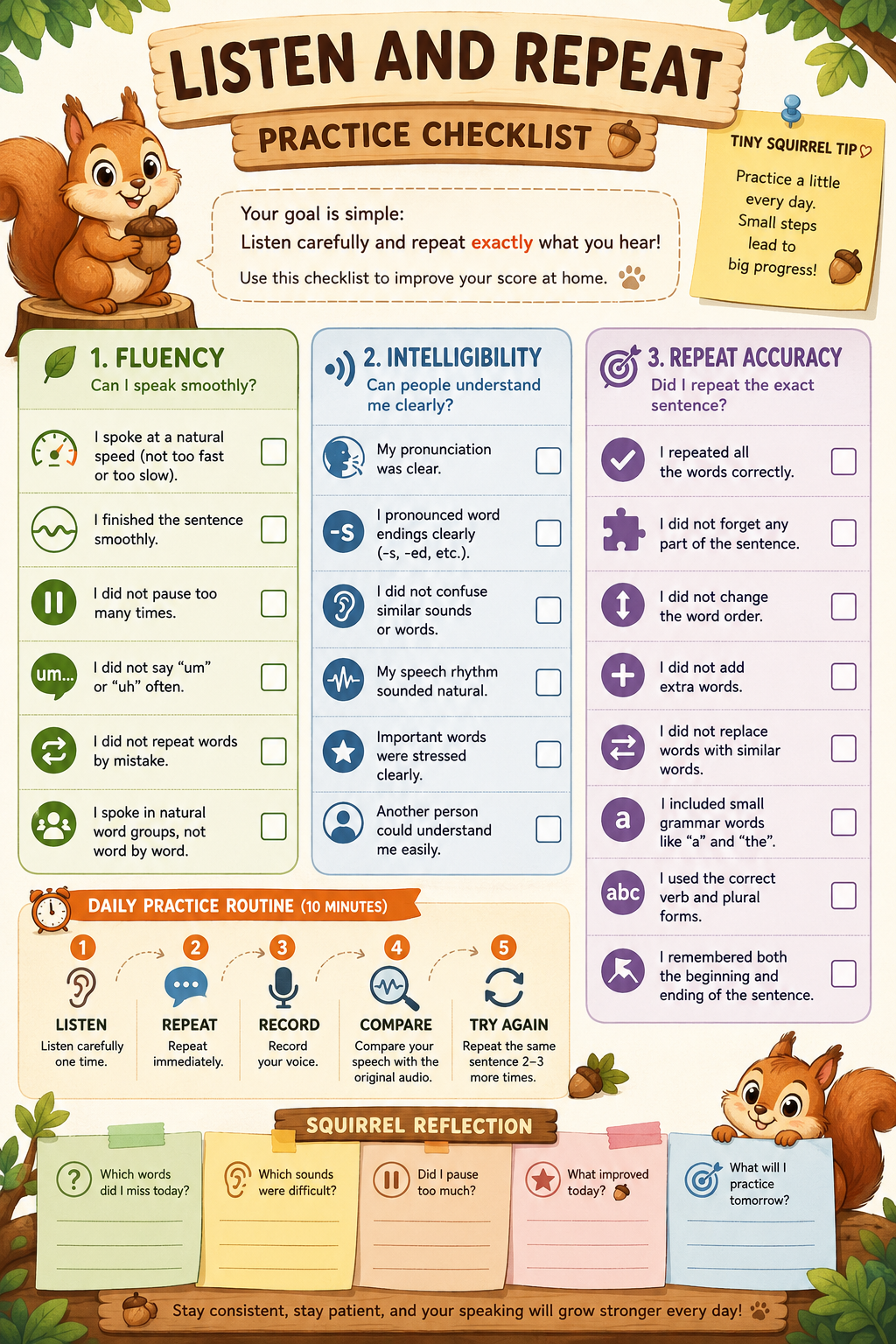
Smart squirrels 🐿️, you probably know that practicing without finding and fixing your mistakes is not very useful. It may even make you repeat the same mistakes again and again.
To help you find your weak points, I prepared a checklist for you. You can print it and complete it after each practice to understand which areas need more work.
How to Fix Your Weak Points
After finding your weak points, the next step is to think about how to improve them. Using the guide below, you can find practice methods for each possible problem and continue your practice in a more focused and effective way.
Here's the same information as clear, easy-to-read text.
Repeat Accuracy
This measures whether you repeat the words correctly.
Tips
- If you replace a word, listen again and practice saying the correct word.
- If a word is difficult, write two sentences using it to become more familiar with it.
- Practice listening at speeds between 1.1× and 1.5× to improve your listening accuracy.
Similarity to the Prompt
This measures how closely your response matches the original sentence.
Tips
- If long sentences are difficult, start with short ones.
- Practice with sentences of 7 words or fewer first.
- Slowly increase the length until you can comfortably repeat 15-word sentences.
- Practice with movies, TED Talks, or YouTube videos using sentences up to 25 words long.
- Repeat exactly what you hear without adding extra words or fillers.
Fluency – Speaking Rate
This measures how naturally and quickly you speak.
Tips
- Read the sentence aloud and try saying it about one second faster than the recorded speaker.
Fluency – Length of Uninterrupted Speech
This measures how long you can speak without stopping.
Tips
- Start by repeating a 5-word sentence without pausing.
- Then move to 6-word sentences and gradually increase the length.
Fluency – Number of Pauses
This measures how often you stop while speaking.
Tips
- Read the transcript aloud and practice connecting words smoothly without unnecessary pauses or extra breaths.
Fluency – Number of Hesitations
This measures how confidently you begin and continue speaking.
Tips
- Start speaking as soon as the audio finishes.
- Practice speaking continuously without hesitation.
- Begin with 5-word sentences, then gradually increase the length.
- Work toward repeating 12-word sentences smoothly.
Intelligibility – Pronunciation
This measures how clearly your words can be understood.
Tips
- Use speech-to-text software to check whether your pronunciation is recognized correctly.
- Practice the words the software misunderstands.
- Write three sentences using difficult words or phrases.
- Read the sentences aloud and test them again with speech-to-text software.
Intelligibility – Rhythm
This measures how naturally your words connect and flow.
Tips
- Read transcripts aloud while linking words together smoothly.
- Practice lowering your intonation naturally at the end of statements.
Intelligibility – Prosody
This measures your word stress and natural speech patterns.
Tips
- Practice words with three or more syllables.
- Make sure you stress the correct syllable and repeat the words until they sound natural.
13 TOEFL Speaking Practice Topics You May Hear on Test Day
Alright, clever squirrels! 🐿️ Let’s gather some useful TOEFL speaking practice topics together. These are the kinds of situations you’re very likely to hear on the real test. I’ve sorted them by setting, and each one includes sample sentences you can practice repeating out loud with your tiny squirrel ears and speedy paws!
Campus Facility Topics
1. University Library
These sentences usually talk about borrowing books, quiet study spaces, and research help.
"Welcome to the central university library."
"Please speak quietly while using the study areas."
"Students may borrow books for up to fourteen days."
"Return borrowed materials to the front counter or the drop box by the door."
"Eating and drinking are not permitted near study spaces or computers."
"Library staff are available to help with research questions during business hours."
"Printing and scanning services are available on the second level."
2. Campus Gym / Fitness Center
Here, you’ll hear sentences about workout equipment, locker rooms, and exercise classes.
"Welcome to the student fitness center."
"Exercise machines are located near the front entrance."
"Weight training equipment can be found in the back section."
"Locker rooms include showers and clean towels for members."
"Group fitness classes are offered throughout the week."
"You can view the class schedule at the information desk."
"If you need assistance, please speak with a staff member at reception."
3. Student Health Center
Expect topics about appointments, medical services, and insurance information.
"The campus health clinic is open Monday through Friday from eight to five."
"Same-day appointments are available for urgent medical concerns."
"Please bring your student identification card and insurance information."
"Free flu vaccines are provided during the fall term."
"Students needing specialist care may request a referral from our staff."
4. Campus Dining Hall
These topics often include meal plans, opening hours, and dietary choices.
"The student dining hall offers breakfast, lunch, and dinner each day."
"Meal plans are available through the online student system."
"Vegetarian meals and allergy-friendly options are marked clearly."
"Please place used trays and dishes in the return area after eating."
5. Student Housing / Dormitory
These orientation-style sentences explain dorm rules and shared facilities.
"Welcome to the university residence hall."
"Quiet hours start at ten o’clock on weekday nights."
"Every floor includes a shared kitchen and laundry facilities."
"Maintenance requests should be submitted through the housing website."
"Your resident assistant is available to provide support and information."
Academic Setting Topics
6. Science Laboratory
These sentences focus on safety rules and lab procedures.
"Welcome to the university chemistry laboratory."
"Protective goggles are required during all lab experiments."
"Food and beverages are not allowed inside the laboratory."
"Chemical materials must be discarded in the proper waste containers."
"Emergency equipment is located near the laboratory entrance."
7. University Bookstore
Topics here usually involve textbooks, returns, and digital materials.
"The university bookstore is inside the student center building."
"Course textbooks are organized by department and course number."
"Books may be returned within fourteen days with a valid receipt."
"Digital access codes cannot be refunded after activation."
8. Lecture Hall / Auditorium
You may hear instructions about presentations, seating, and technology use.
"Please take a seat before the lecture begins."
"Make sure your mobile phone is turned off or silenced."
"Students may not record the presentation without permission."
9. Computer Lab
These sentences usually discuss lab access, printing, and reservations.
"The computer center is available to all students with a university ID."
"Each student receives free printing credits every semester."
- "Please save your files regularly because the computers restart automatically overnight."
Community and Daily Life Topics
10. International Airport
These topics often cover security procedures, boarding, and luggage rules.
"Welcome to the international terminal."
"The baggage claim area is located straight ahead."
"Please prepare your boarding pass and identification for security screening."
"Carry-on liquids must be stored in transparent plastic bags."
"Do not leave personal belongings unattended."
"Flight updates may be sent through the airline’s mobile application."
11. Hotel Check-in
Expect sentences about hotel services, room policies, and amenities.
"Welcome to the Grandview Hotel. We’re happy to have you as our guest."
"Check-in begins at three in the afternoon, and check-out is at eleven in the morning."
"Breakfast is served daily in the first-floor dining room."
"Additional toiletries are available from the front desk upon request."
"Please keep noise levels low after ten p.m."
"The fitness room and swimming pool are open every day from seven a.m. to nine p.m."
"Contact the front desk if you need assistance during your stay."
12. Art Gallery / Museum
These sentences guide visitors through exhibits and museum rules.
"Welcome to the city art museum."
"Visitors may use a free audio tour during their visit."
"Digital maps are available to help guests navigate the exhibits."
"Please speak with a staff member if you need assistance."
"Flash photography is not permitted inside the gallery."
"A quiet seating area is available for visitors who wish to relax."
"Please return your audio device before leaving the museum."
13. Zoo / Botanical Garden
These topics include animal areas, safety instructions, and visitor services.
"Our zoo is home to many different animal species."
"Bears and wolves are located on the right side of the park."
"Sea lions and elephants can be seen farther along the path."
"Outside food and drinks are not allowed near the animal areas."
"Please do not tap on the glass or disturb the animals."
"Educational programs and summer activities are available for children."
"Additional information can be found at the visitor center near the entrance."
A Nutty Farewell
Well done, little squirrels! 🐿️
We went through everything you need to know about Speaking Task 1!
But we’re not finished yet. You need to practice every day and try to improve little by little.
I’ll be here with you, so feel free to leave a comment if you have any questions. I’ll jump in to help as soon as I finish cracking my nut! 🌰