Speaking guides
TOEFL Speaking 2026 Take an Interview Task
Everything You Need to Know about TOEFL Speaking Take an Interview Task
Hello dear test-takers! Nutty the Squirrel here, ready to guide you through the TOEFL Speaking Task 2!
In this part of the test, you will join a simulated online interview. You will see an interviewer on the screen in a short repeating video, and they will ask you four questions about everyday life topics.
The conversation is designed to feel similar to a university interview or a simple research study. Don’t worry, the topics are very normal and familiar. Nothing strange will jump out of the bushes!
Grab a comfy branch, and I’ll walk you through everything clearly and smoothly.
Ready to stash away some knowledge?
Let’s go!
What Task 2 Looks Like
Take an Interview (Questions 8–11)
TOEFL Speaking Task 2 is a simulated online interview. You’ll see a pre-recorded video of an interviewer who asks you four questions, one at a time.
Before the interview begins, you will hear directions explaining the topic and the reason for the interview. After that, the interviewer will ask four questions connected to the same general theme.
Example:
As part of a university project, you have agreed to take part in a short research interview about health and wellness habits. A graduate student conducting the research will ask you some questions online.

After hearing the instructions, you will be asked 4 questions, one at a time.
For each question, you will have 45 seconds to answer.
Here are a few important little acorns to remember:
- There is no preparation time.
- You must begin speaking immediately after the question finishes.
- There is no beep like in the Listen and Repeat task.
- You can only hear the questions, you cannot read them on the screen.
Question: Is the interviewer a real person?
The interviewer is a video of a real person, but the video was recorded before the test. It is not a live conversation. While you speak, the interviewer appears to nod and listen. This helps the interview feel more natural. However, the interviewer cannot hear you or react to your answers.
Question: If it’s a video, can I replay it and listen to the question again?
No, you can hear the question only once and the 45s answering time will start immediately.
Types of Questions
Little acorn friend, the four interview questions usually follow a pattern. 🌰 While the topic changes, the types of questions are often very similar. Knowing what to expect can help you feel more confident on test day.
Question 1: Your Personal Experience
The first question usually asks about something you have done, used, or experienced in your daily life. The interviewer wants you to describe a real situation from your own experience.
For example, you might be asked:
- Have you ever taken part in a school club? What activities did you do there?
- What kinds of books do you usually read in your free time?
- What types of apps do you use most often during the day?
This question is usually concrete and easy to answer because it is about your own life.
Question 2: Your Preference
The second question often asks what you prefer and why. There is no right or wrong answer. The important thing is to give a clear reason for your choice.
For example:
- Do you prefer studying alone or with classmates? Why?
- When you travel, do you like planning everything ahead of time or being spontaneous? Why?
- Do you prefer shopping online or in stores? Why?
Question 3: Your Opinion About the Future or on an issue
The third question often asks you to think about what may happen in the future. You will need to give your opinion and explain your reasons.
For example:
- Do you think online learning will become more common in the future? Why or why not?
- Will people use public transportation more often in the future? Why?
- Do you think new technology will make everyday life easier or more difficult? Why?
Question 4: Your Opinion About an Abstract Idea
The final question is usually the most general. It asks for your opinion about a broader idea or issue. You may need to choose between two viewpoints and explain which one you agree with.
For example:
- Some people believe competition helps people improve, while others think cooperation is more important. Which view do you agree with?
- Some people think students learn better from teachers, while others believe they can learn just as well online. What do you think?
- Some people say social media brings people closer together, while others think it makes people feel lonely. Which opinion do you agree with and why?
Possible Topics
The topics vary, but they are usually something you have a personal experience with and can discuss. Such as:
● Lifestyle: sports, hobbies, exercise
● Habits: travel, dietary, technology
● Education: study habits, learning style
● Social: spending time with friends, shared routines
Grading
Your responses are scored using four main areas:
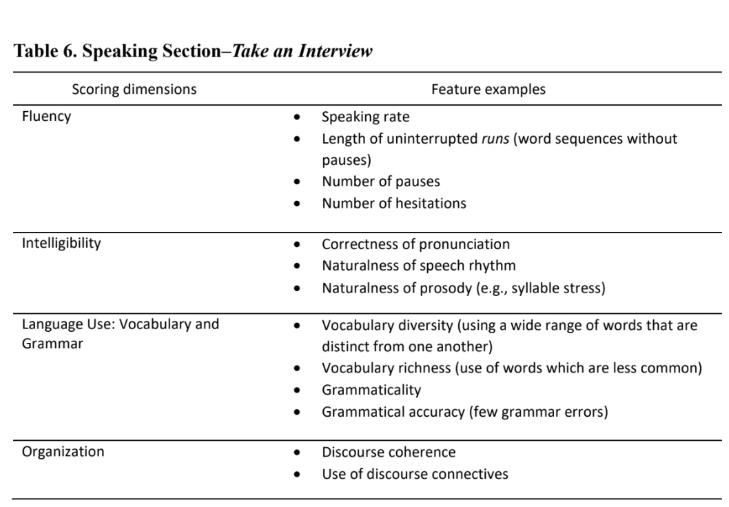
Source: ETS.com
Important tips:
- Fluency: The goal is to speak at least 110 words in 45 seconds. Note that the most important thing in this dimension is “speed”, meaning how many words you can say in 45 seconds. That doesn’t mean to just keep mumbling! Words because it would harm the other scoring dimensions.
- Intelligibility: The most important thing for this dimension is “intonation”.
Question: How can I improve my intonation?
Improving intonation is mostly about training your ear and giving your voice more “shape” instead of speaking in a flat line. Here is a practical way to work on it: Start by listening more actively than you speak. Pick short clips from native speakers (YouTube, interviews, TV scenes). Don’t just listen to words and focus on how the pitch rises and falls. Pause after sentences and try to imitate the melody exactly, not just the pronunciation. This “shadowing” technique is one of the fastest ways to improve intonation.
- Language Use: This is mainly about your vocabulary and grammar, but a lot of students misunderstand it and think they should use fancy words or very complicated grammar in order to get a high score. The most important thing is to use a variety of words (don’t just repeat the same word over and over, you can use the synonyms) and use accurate grammar.
- Organization and Relevancy: How clearly your ideas connect to the question.
| Function | Linking Words & Phrases |
|---|---|
| Showing sequence | to begin with, moving on to the next reason, secondly, thirdly, subsequently, on top of that, later, after this, finally |
| Adding more information | another thing that comes to mind, also, and, besides, additionally, another good example of this is, another reason for this, and one more thing |
| Giving opinion / attitude | unfortunately, however, actually, to be honest, definitely, essentially, frankly, basically, clearly, I’m afraid, if you ask me, sadly, thankfully, in fact, seriously, as a matter of fact |
| Comparing | similarly, in the same way, equally, likewise, in a similar fashion, if I compare it to my country, however, although, instead of, despite, on one hand, on the other hand, in contrast, whereas |
| Giving examples | a great example of this is, for example, for instance, a personal example is, in other words, a clear example of this can be seen, such as, illustrated by |
| Showing result / conclusion | as a result, because of this, therefore, consequently, so, then |
Templates
A common mistake among test takers is treating the new version of the TOEFL like the old one, where there was a fixed template for each type of question and answers were built based on those patterns. In the new version, however, there is a much wider variety of questions, and it becomes very difficult to rely on memorized templates, since the question you receive may be different from what you prepared for, which can lead your response to go off-topic and reduce your score.
Instead of memorizing a fixed template, we suggest you use this structure and talk about your ideas using that.
The structure is simple:
1st -answer the question
2nd - give a reason
3rd - provide a personal example
4th - show the consequence
Let’s check this out with an example:
As part of a university project, you have agreed to take part in a short research interview about health and wellness habits. A graduate student conducting the research will ask you some questions online.
Question 1: Thank you for agreeing to participate. I'd like to ask you some questions about your health and wellness habits. First, do you have any specific routines or practices you use to maintain your physical well-being? If so, what are they?
Sample answer:
Hmm, that's a good question. Yes, I do have several routines that help me maintain my physical well-being. I follow these routines because I want to stay healthy, have more energy, and avoid health problems in the future. For example, I exercise at least four times a week by going for a walk, jogging, or doing a short workout at home. I also try to get seven to eight hours of sleep every night and drink plenty of water throughout the day. As a result, I usually feel more energetic and focused, especially when I have a busy schedule. In addition, these habits help me manage stress and improve my overall mood. Because of these routines, I can stay productive and feel better both physically and mentally.
Question 2: Thank you. Can you describe any dietary choices or habits that you follow to stay healthy? Give details to explain your answer.
Sample answer:
Yes, I do follow some dietary habits to stay healthy. One of my main habits is eating balanced meals and limiting junk food because I want to have enough energy throughout the day and maintain good overall health. For example, I usually prepare my own lunch and include vegetables, lean protein, and whole grains instead of ordering fast food. As a result, I feel more energetic, stay focused for longer periods, and rarely experience the tiredness that I used to feel after eating unhealthy meals.
Question 3: Interesting. If you could make one significant change to your diet or exercise routine to stay healthy, what would it be? Why would you make that particular choice?
Sample answer:
If I could make one significant change to my diet or exercise routine, I would exercise more consistently throughout the week. I would make this change because regular physical activity is important for maintaining good health, reducing stress, and improving energy levels. For example, there have been many weeks when I was busy with work or studying and only exercised once or twice, even though I planned to work out more often. As a result, I felt less energetic and had difficulty staying focused during the day. I think that if I followed a regular exercise schedule, I would feel healthier, be more productive, and have a better overall quality of life.
Question 4: Great. Some people believe that mental health is just as important as physical health, and should be given equal attention. Do you agree or disagree with this viewpoint? Why?
Sample answer:
Yes, I completely agree that mental health is just as important as physical health. I believe this because mental health affects how we think, feel, and handle everyday challenges. For example, during a particularly stressful period at school, I found it difficult to concentrate on my studies and stay motivated, even though I was physically healthy. As a result, my performance declined and I felt exhausted most of the time. That experience taught me that taking care of mental health is essential for overall well-being. When people maintain good mental health, they are often happier, more productive, and better able to take care of their physical health as well.
How to Fix Your Weak Points
Little squirrel learners 🐿️🌰, the TOEFL Speaking section measures several important speaking skills. Each scoring area checks a different part of your English ability, from organization and vocabulary to fluency and pronunciation. Here’s a clear guide to what the test looks for and how you can practice each skill more effectively.
Organization – Discourse Coherence
This measures how clearly and logically your ideas are organized.
Tips
- Add a personal example to make your answer longer and easier to follow.
- Spend a few seconds planning what you will say first, next, and last.
- If your answer feels disorganized, use a simple structure: beginning → middle → ending.
Organization – Discourse Markers
This measures how smoothly you connect your ideas.
Tips
- Use at least two transition words or phrases, such as for example, however, also, or in addition.
- Begin your answer with a natural opening, such as That's an interesting question or In my opinion.
Language Use – Vocabulary Depth
This measures how accurately and naturally you use vocabulary.
Tips
- Learn two new words or expressions before each practice session.
- Write a few sentences using them before speaking.
- Avoid repeating simple words like good, nice, or bad too often.
Language Use – Vocabulary Diversity
This measures how much variety you use in your vocabulary.
Tips
- Learn synonyms for common words such as good, important, and happy.
- After writing your transcript, replace 5–10 repeated words with better vocabulary.
- Read the improved version aloud.
Language Use – Grammatical Accuracy
This measures how correctly you use grammar.
Tips
- Focus on using correct present, past, and present perfect tenses.
- Make sure your subject and verb agree.
- Review which verb tense fits each question type.
Language Use – Grammatical Range
This measures how much variety you use in your sentence structures.
Tips
- Use conjunctions such as and, but, because, and although.
- Practice using more advanced grammar, such as conditional sentences (If I had more time...).
- Try starting some answers with an If... sentence.
Fluency – Speaking Rate
This measures how naturally and smoothly you speak.
Tips
- Prepare a few useful phrases before speaking.
- Practice your opening and closing sentences.
- Read your transcript a little faster each time while keeping your pronunciation clear.
- Aim to gradually increase the number of words you can say in 45 seconds.
Fluency – Sustained Speech
This measures how well you keep speaking without stopping.
Tips
- Try to use five or fewer fillers such as uh or um.
- Replace fillers with smoother expressions like well, so, or okay.
- Use transition words to connect your ideas naturally.
Fluency – Pause Frequency
This measures how often you pause while speaking.
Tips
- Practice shadowing a native speaker and copy their rhythm.
- Read your transcript aloud while connecting phrases smoothly.
- Practice saying one short sentence in a single breath.
Fluency – Repetitions
This measures how often you repeat the same words or ideas.
Tips
- Use synonyms instead of repeating words like good or interesting.
- Spend a few seconds planning your ideas before speaking.
- Better planning helps reduce repeated words and phrases.
Intelligibility – Pronunciation
This measures how clearly people can understand your speech.
Tips
- Listen to your recordings and find words that are difficult to pronounce.
- Practice two difficult words or phrases before your next response.
- Write practice sentences using those words and say them aloud.
Intelligibility – Rhythm
This measures how naturally your speech flows.
Tips
- Shadow native speakers and copy their rhythm.
- Read your transcript aloud while linking words together naturally.
- Pay attention to where native speakers pause.
Intelligibility – Prosody
This measures your word stress and intonation.
Tips
- Find at least two words with three or more syllables in your response.
- Check which syllable should be stressed.
- Practice saying those words with the correct stress and natural intonation.
Common Challenges among Students
- Freezing after hearing the question
In TOEFL Speaking Task 2, since there is no preparation time and the timer starts immediately after you hear the question, many students tend to freeze and lose the first few seconds of their speaking time, like a squirrel suddenly forgetting where it hid its acorns 🐿️. This is a serious issue because it can reduce their overall score.
That is why it is very important to start your response strongly and with confidence. The first few seconds set the tone of your whole answer.
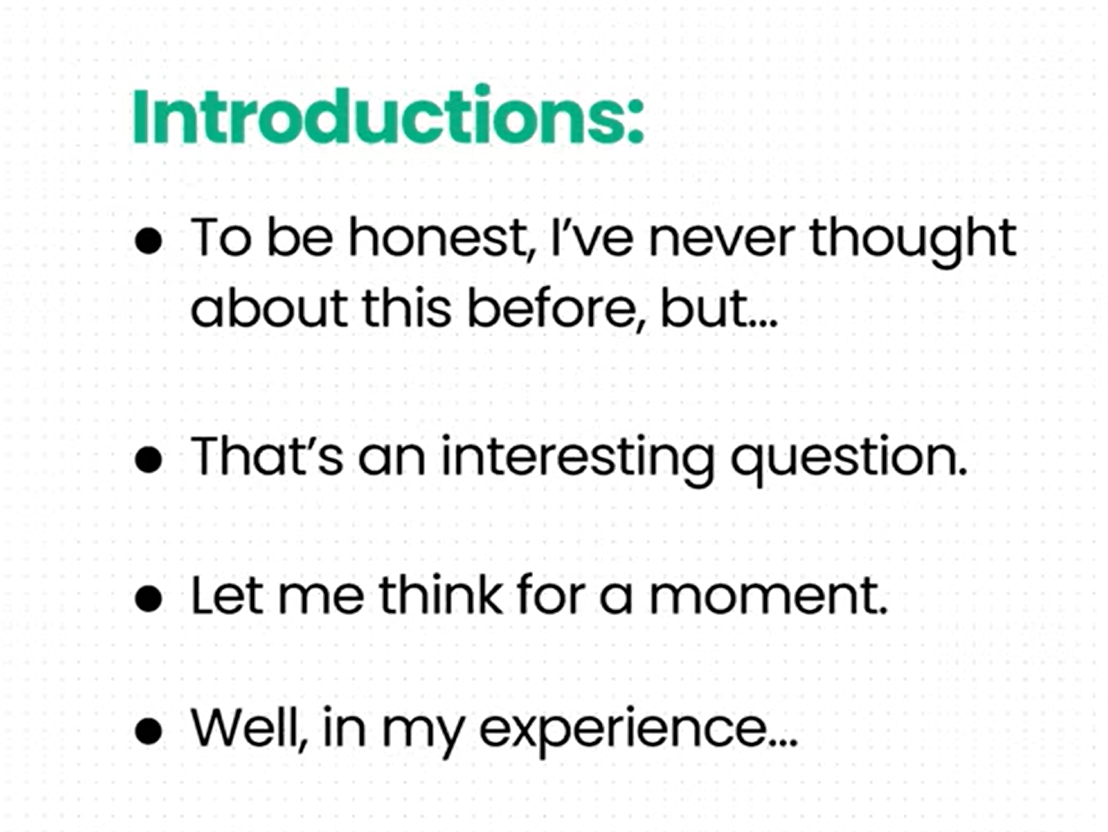
To do this, you can memorize a few fixed opening sentences in advance, so you can use them immediately after hearing the question. This helps you avoid wasting time thinking at the beginning, and instead lets you start speaking smoothly right away. After that, you can naturally continue with your actual ideas and examples.
For example, having ready-made starters like “I personally believe that…” or “In my opinion, the best choice is…” can give you a quick and stable beginning, so your answer flows better and you don’t lose valuable speaking time.
Some useful sentences you can use:
- Not being able to speak for 45 seconds
Many test takers struggle to speak for the full 45 seconds. Since this can lower their score, it is a major concern for many students. To help you stretch your answer naturally without sounding forced or repetitive, there are three effective ways to expand your response, depending on the type of question. Think of them as three different squirrel paths leading you to the same tree 🐿️🌳:
- Provide an example
- State your opinion.
- Give a reason.
- Support it with a personal example.
- Explain the result or consequence.
- Contrast ideas
Use the following structure: - State your opinion.
- Explain the reason for your opinion.
- Acknowledge the other side of the argument.
- Conclude by reinforcing your position.
- Have mixed feelings
- 1. Describe your feelings
Well, to be honest, I have mixed feelings about this question.
- 2. Introduce and elaborate one side
On the one hand,
- 3. Introduce and elaborate the other
On the other hand,
*Acknowledge both sides at the end (optional)
A Nutty Farewell
Well done, little squirrels! 🐿️
We went through everything you need to know about Speaking Task 2!
But we’re not finished yet. You need to practice every day and try to improve little by little.
I’ll be here with you, so feel free to leave a comment if you have any questions. I’ll jump in to help as soon as I finish cracking my nut! 🌰