Reading guides
TOEFL Reading 2026 Task 2
TOEFL Reading 2026 Task 2 - Reading in Daily Life
Hello dear test-takers! Nutty the Squirrel here! Time to collect another reading acorn!
Today we want to talk about the Reading section, Task 2!
This task uses texts that people commonly read in everyday life.
You might see:
- A poster, sign, or notice
- A menu
- A social media post or web page
- A schedule
- An email
- A chain of text messages
- An advertisement
- A news article
- A form
- An invoice
- A receipt
After reading the text, you'll answer two or three multiple-choice questions, depending on the length of the text.
There are two types of text, depending on the length. Read in Daily Life (short) and Read in Daily Life (long).
We’ll explain everything detailed later in this article. Grab a comfy branch, and I’ll walk you through everything clearly and smoothly.
Ready to stash away some knowledge?
Let’s go!
Reading in Daily Life (short)
In the Reading in Daily Life (Short) task, you will read a short text that you might see in everyday life. It could be something you read on campus, at work, or during your daily activities.
The text is usually about 15–50 words long and is followed by 2 multiple-choice questions.
You might read:
- An email
- A text message
- A campus notice
- A schedule
- A sign or poster
- A menu
- A receipt or invoice
- A social media post
- A short advertisement
The questions are usually simple because the texts are short. They often ask about the main idea, the purpose of the message, or an important detail.
What Does It Look Like?
Let’s see an example together:
From: Maya Chen
To: Ben Lee
Hi Ben,
The library will close at 6:00 p.m. today because of a staff meeting. If you still need the history book, could you return it before 5:30? I can bring it back tomorrow if you still need it.
Thanks!
Questions
1. Why did Maya send this email?
A. To invite Ben to the library
B. To remind Ben about the library's closing time
C. To ask Ben to buy a history book
D. To tell Ben about tomorrow's class
✅ Answer: B
2. What does Maya ask Ben to do?
A. Borrow another book
B. Meet her tomorrow
C. Return the book before 5:30
D. Call the library
✅ Answer: C
Tips for Solving Reading in Daily Life (Short)
🐾 Read the Whole Text
The passages are short, so read everything before looking at the questions.
Unlike the old TOEFL, you don't need to search through a long passage. Reading the whole text only takes a few seconds.
🐾 Find the Main Purpose
The most common questions ask about the “main point” or “main topic” of a reading or ask “why” it was written.
For example:
- Why was this email written?
- What is the main purpose?
- What is the writer trying to do?
Instead of focusing on one sentence, think about the whole message.
For example, if an email talks about a schedule change and asks someone to arrive earlier, the purpose is probably to inform someone about the change, not simply to mention the time.
🐾 Keep Track of People
Pay attention to who is doing what.
Ask yourself:
- Who sent the message?
- Who receives it?
- Who needs to take action?
This helps you avoid mixing up the people.
🐾 Watch Out for Paraphrases
The correct answer often uses different words from the passage.
For example:
Text:
Please submit the form by Friday.
Question:
What does the writer ask the reader to do?
Correct answer:
Complete the registration before the deadline.
The words are different, but the meaning is the same.
🐾 Don't Spend Too Much Time
These questions are usually straightforward.
Answer them, collect your reading acorns, and move on!
Reading in Daily Life (Long)
The Reading in Daily Life (Long) task is very similar to the short version, but the text is longer.
The passage is usually about 100–150 words, and you will answer 3 multiple-choice questions.
The texts are still things you might read in everyday life, such as:
- Emails
- Notices
- Website pages
- Membership information
- Advertisements
- Instructions
- Forms
- News articles
Because the passage is longer, you'll need to remember a few more details.
What Does It Look Like?
Subject: Community Volunteer Program
Hello Sarah,
Thank you for joining our Community Volunteer Program!
As a volunteer, you'll receive a monthly newsletter, invitations to local events, and free training workshops. Before you begin, please log in to your account and complete your personal profile by adding your phone number and emergency contact. This information helps us contact you quickly if needed and recommend volunteer activities that match your interests.
We look forward to working with you!
Best,
Volunteer Services
Questions
1. Why did Sarah receive this email?
A. She signed up for a volunteer program.
B. She applied for a full-time job.
C. She cancelled her membership.
D. She requested emergency assistance.
✅ Answer: A
2. What must Sarah do before volunteering?
A. Attend a workshop
B. Add information to her profile
C. Call Volunteer Services
D. Choose a volunteer leader
✅ Answer: B
3. Why is the organization asking for Sarah's information?
A. To advertise local businesses
B. To recommend suitable volunteer activities
C. To create a public website
D. To check her education history
✅ Answer: B
Tips for Solving Reading in Daily Life (Long)
🐾 Scan the Whole Text
Read the entire text once before answering.
The passage is still short enough to read quickly.
🐾 Identify the Purpose
Ask yourself:
- Why was this email sent?
- Why was this notice posted?
- Why was this message written?
Knowing the purpose often helps you answer the first question.
🐾 Notice Important Details
Pay attention to information like:
- Dates
- Times
- Deadlines
- Requirements
- Benefits
- Instructions
These will often come up in questions.
🐾 Keep Track of Actions
Notice who is doing what.
For example:
- Who needs to complete a form?
- Who receives the information?
- Who gives the instructions?
Small details like these can make the difference between two similar answer choices.
🐾 Make Simple Inferences
Sometimes the answer is not written exactly.
For example:
Text:
Completing your profile helps us recommend volunteer activities that match your interests.
Question:
Why does the organization collect this information?
Correct answer:
To make better recommendations.
The questions not always use those exact words, but the meaning is the same.
🐾 Watch Out for Distractors
ETS often includes answer choices that contain words from the passage but do not answer the question.
For example:
The email says volunteers receive free workshops and must complete their profile.
Question:
What must Sarah do before volunteering?
One wrong answer says:
Attend a workshop.
Workshops are mentioned in the email, but they are a benefit, not a requirement.
Always answer the question, not the word that looks familiar.
Also Watch out for answers that appear too easy. Look at this example:
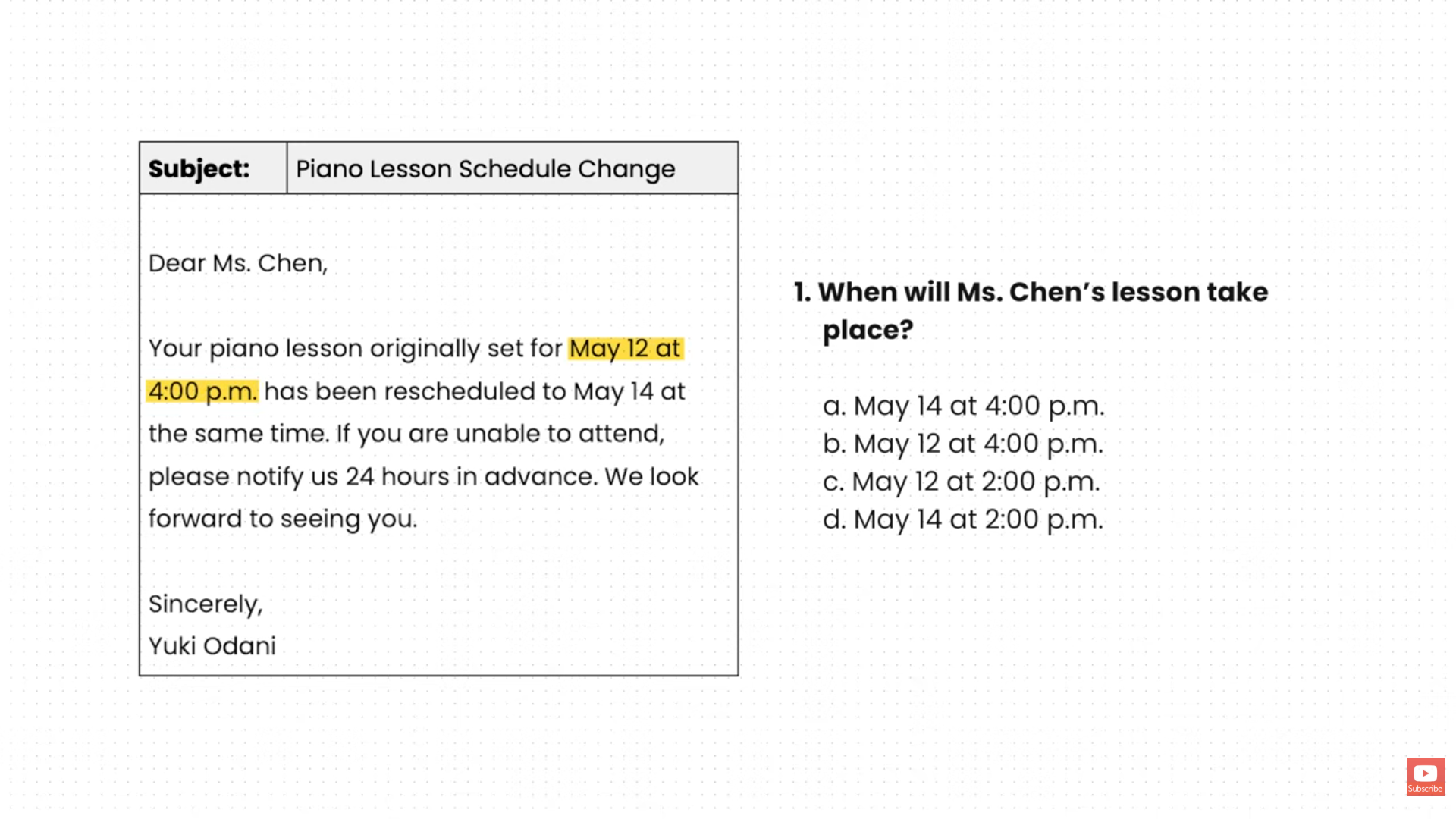
If you are not careful, you will immediately choose B, while the correct answer is A. The questions are meant to be trickier than just simply seeing and choosing the answer so be careful.
🐾Read All the Answer Choices
Sometimes more than one answer looks correct at first. One choice may include words from the passage, while another matches the real meaning.
A Nutty Farewell
Well done, little squirrels! 🐿️
We went through everything you need to know about the Reading section, Task 2!
But we’re not finished yet. Go through the next articles to learn about each task, and practice practice practice!
Let me know in the comment sections if you have any further questions!