Reading guides
TOEFL Reading 2026 Task 1
TOEFL Reading 2026 Task 1 - Complete the Words
Hello dear test-takers! Nutty the Squirrel here, ready to guide you through the TOEFL Reading section, Task 1.
The first task of the new TOEFL Reading tasks is called Complete the Words. In this task, you will read a short academic paragraph, but some words will be missing their final letters. Your job is to complete those words correctly.
Sounds new and confusing? Don’t worry! We’ll explain everything detailed later in this article. Grab a comfy branch, and I’ll walk you through everything clearly and smoothly.
Ready to stash away some knowledge?
Let’s go!
The Structure of Reading Task 1
What Does It Look Like?
🐿️ Imagine you see something like this:
Urban gardens are becoming more popular in many cities. They provide fresh food and help residents develop stronger community relations. In addition, these spaces can encour_ _ _ people to spend more time outdoors and improve their overall well-being _ _ _.
You would need to complete:
- encourage
- well-being
Notice that the beginning of each word is already provided. You only need to figure out the missing ending.
Let’s see another example together:
Fill in the missing letters in the paragraph.
(Questions 1-10)
The history of the South Pacific is marked by diverse cultures and significant events. Indigenous popul developed com societies wi rich tradit and soc structures. T region’s polit and econ landscapes exper profound chan following colonization by Europeans. Studying this history allows for a greater understanding of cultural interactions and the ongoing effects of historical events on contemporary South Pacific societies. Traditional navigation techniques using stars and ocean swells enabled remarkable voyaging achievements, while contemporary movements focus on cultural preservation, language revitalization, and addressing climate change impacts on island nations.
Format
- Paragraph Length: ~70 - 100 words
- Missing Letters: ~10 words have blanks within them
- Task: Type the missing letters to complete each word
Here’s what you can expect on test day:
- The paragraph is usually about 70–100 words long.
- It often explains an academic idea, term, or concept, similar to something you might find in a textbook or article.
- The first sentence is complete.
- In the next sentence (and sometimes the third sentence), parts of some words are missing.
- There are 10 incomplete words, so this task is worth 10 questions.
- The missing letters are always in the second half of the word, not the beginning.
- You will see exactly how many letters are missing, which gives you an important clue.
- The difficulty of this task stays the same in all modules, so it does not become harder or easier.
Tips for Solving This Task
🐾 Read the Whole Paragraph First
Before filling in any missing letters, quickly read the entire paragraph.
The topic often gives you useful clues about what the missing words might be. The more you understand the general meaning, the easier it becomes to guess the correct words.
For example, if the paragraph is about education, words like learning, students, knowledge, or academic become more likely.
🐾 Look for Common Word Endings
Since the missing part is always at the end of the word, think about common endings.
For example:
| Beginning | Possible Word |
|---|---|
| investiga___ | investigate |
| carefu___ | carefully |
| educat___ | education |
Many TOEFL words belong to academic word families, so recognizing common endings can help you solve questions faster.
🐾 Identify the Word Type
Ask yourself:
- Is this a noun?
- Is this a verb?
- Is this an adjective?
- Is this an adverb?
The words around the blank usually tell you what type of word is needed.
🐿️ For example:
Students must work cooperati_ _ _ _ _ _ to complete the project.
After the verb work, we usually need an adverb.
The answer is:
cooperatively
🐾 Use Grammar Clues
Grammar can often help even when you do not know the exact word.
For example:
The scientist carefully observ______ the results.
After scientist, we need a verb.
The sentence is in the past tense, so the answer is likely:
observed
Looking at grammar is like finding tiny acorn clues hidden in the paragraph!
🐾 Build Your Academic Vocabulary
The paragraphs come from academic-style texts, so you will often see words commonly used in education, science, history, business, and social sciences.
The vocabulary is not usually extremely difficult, but it is more formal than everyday English.
Studying the Academic Word List (AWL) can help you become familiar with many words that often appear in this task.
🐾Type in letters to check ideas
You can just type in the letters to see if they fit or not. Using your visual memory helps you guess the letters.
🐾Think of different subjects for answers
Repeating the same subject (the “who/what” of a sentence) makes the text boring. So in a lot of times, different subjects are used instead of the same word.
Example:
- Dogs are friendly.
- They are loyal. (pronoun)
- These playful animals need daily exercise. (demonstrative + adjective + noun)
Why is this important?
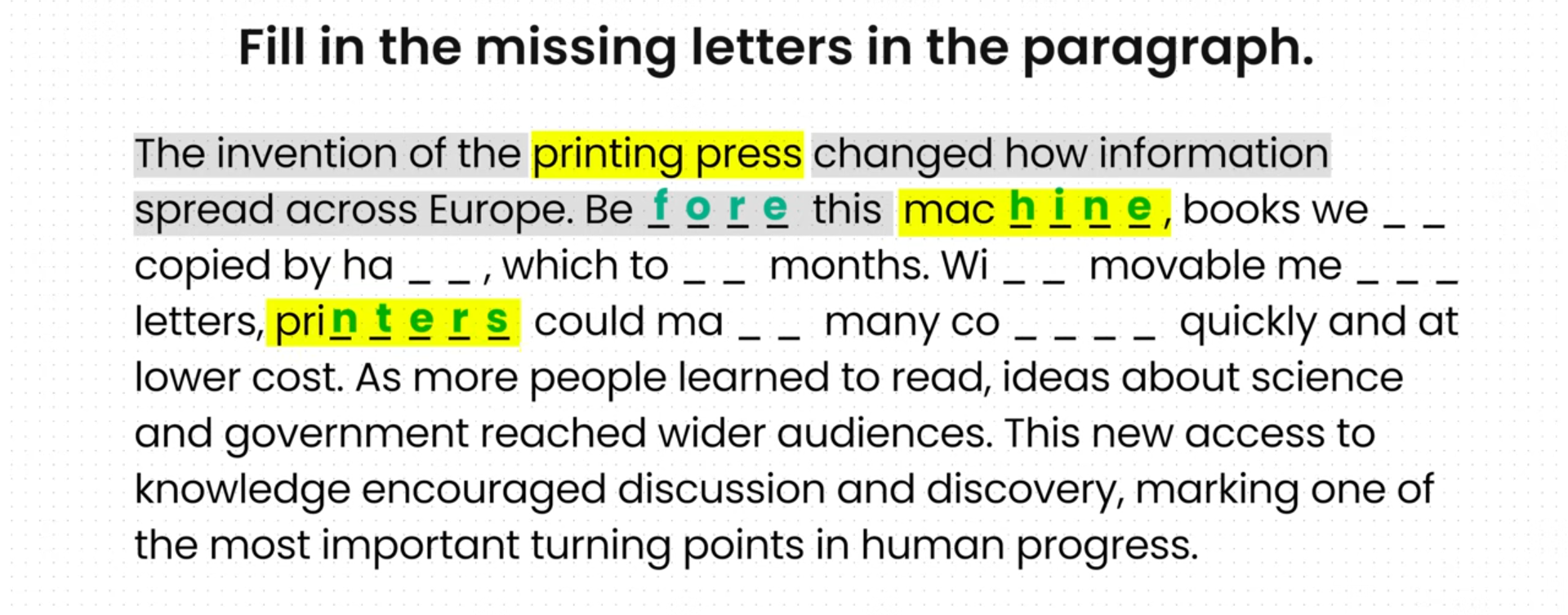
In Reading Task 1, you need to guess the blank words, and a lot of times, the missing words are the subject of the sentence. So by looking at the previous sentences, you can guess the missing letters easier.
Example:
More practice:
- movies → they → these entertaining stories
- Sofia → she → that talented singer
- driving → it → that stressful activity
- mountains → they → those majestic peaks
- history → it → that fascinating subject
🐾 Don't Get Stuck
Sometimes you may not know a word.
If that happens:
- Make your best guess.
- Move on.
- Come back later if you have time.
Many students lose too much time trying to solve one difficult word. Remember, you do not need every answer to be correct to earn a high score.
A Nutty Farewell
Well done, little squirrels! 🐿️
We went through everything you need to know about the Reading section Task 1.
But we’re not finished yet. Go through the next articles to learn about each task, and practice practice practice!
Let me know in the comment sections if you have any further questions!