Writing guides
Everything You Need to Know about TOEFL Writing 2026
Everything You Need to Know about TOEFL Writing 2026
Yay! We’ve jumped all the way to the 3rd section of the TOEFL: Writing! Good job, fellow nut-collector! By now, your brain might feel a little tired from the last two sections, so the Writing section can be a tricky nut to crack. But don’t worry—we’ll break it into bite-sized pieces so you can tackle it even if you feel a bit sleepy.
In this guide, I will help you step by step, using tips from all the reliable sources, so you can understand the basics of Writing. So grab your coffee ☕, get comfortable, and let’s dive in!
Ready to stash away some knowledge?
Let's go!
The 2026 TOEFL® Writing vs. The Old Version
Before we talk about the format of TOEFL Writing, let’s take a quick look at the changes made to the TOEFL Writing section since January 21st, 2026.
The 2026 TOEFL® Writing section looks very different from the older version. It is now shorter, faster, and more focused on practical communication instead of long academic essays.
Previously, students completed two tasks: Integrated Writing and an Academic Discussion In the new version, there are three task types: Build a Sentence, Write an Email, and the former Academic Discussion.
Another big change is timing. The old Writing section took about 30 minutes, but the new version lasts only around 23 minutes. Even though there are now 3 tasks instead of 2 tasks, each one is shorter and quicker to complete.
The scoring system has changed too. Before, scores were given on a 0–30 scale. Now, the Writing section uses a 1.0–6.0 scale with 0.5-point increments.
| Area | Old TOEFL® Writing | 2026 TOEFL® Writing |
|---|---|---|
| Tasks | Integrated Writing & Academic Discussion | Build a Sentence, Write an Email & Academic Discussion |
| Focus | Academic essay writing | Practical communication skills |
| Number | 2 tasks | 3 tasks |
| Timing | About 30 minutes | Around 23 minutes |
| Scoring | 0–30 scale | 1.0–6.0 scale |
The Structure of Writing Section
Alright, little squirrels, let’s dive into each task together and take a closer look! 🐿️
Task 1: Build a Sentence
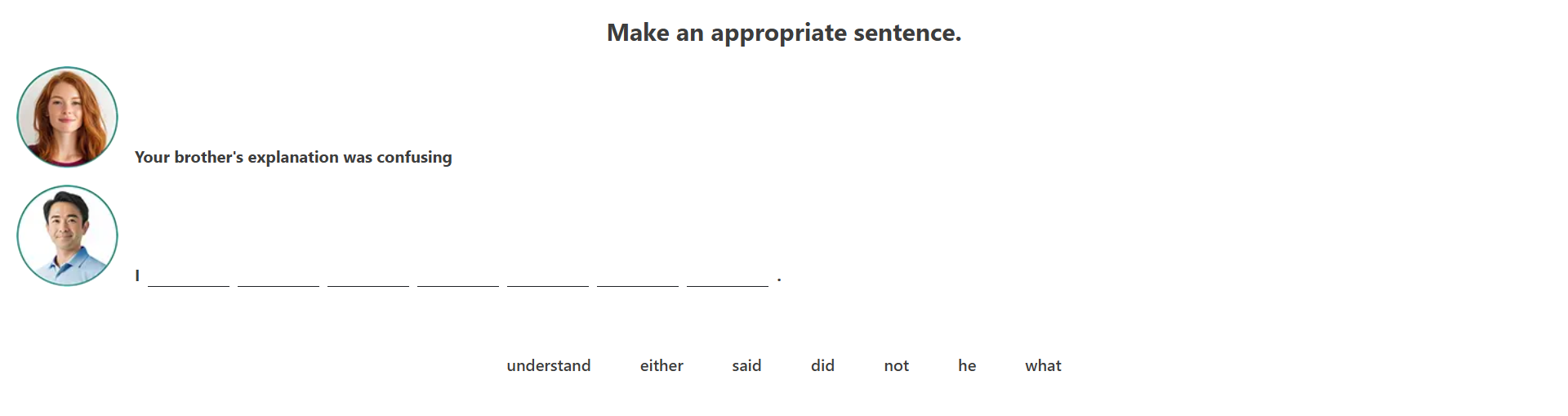
In this part, your job is to put mixed-up words back into the correct order to make complete and grammatically correct sentences. Here’s how the task works from my tiny nut-storing paws to yours:
You will get ten sentences, but only one will appear on the screen at a time. Some of the sentences will be regular statements, while others will be questions.
For each one, the answer is already there, but oh no, the words have been shuffled around like acorns in the wind! Most sentences will have around five to seven words.
Your mission is to click and drag the words into the correct order to build a proper sentence. Keep your squirrel eyes sharp, because sometimes there will be one extra word hiding there that you do not need to use at all.
You will have about seven minutes to finish all ten sentences. The good news? You can move backward and forward between questions and use your time however you like.
Example:
Task 2: writing an email
Now let’s scamper over to the second TOEFL Writing task, little acorn collectors! 🐿️📧
In this task, you must write an email based on a situation described in the question. Many test takers find this part a little tricky because the time is short, usually only seven minutes, and it is very important to use the correct tone, structure, and level of politeness.
First, you will read a short paragraph explaining the situation. For example, you might need to ask a professor for extra time on an assignment, explain a problem, invite a friend to study together, give feedback, or handle another social or academic situation.
After the paragraph, you will see three bullet points. Your email must include and answer all three points clearly. If even one bullet point is missing, your response may lose points, so make sure you cover everything carefully with your tiny squirrel paws.
Your response will be scored based on several things: how polite and appropriate your email sounds, how well your ideas connect together, whether you fully answer the task, and also your grammar, vocabulary, spelling, and punctuation.
Example:
Your instructor has asked students to propose ideas for the final course project.
Write an email to your instructor. In your message, be sure to:
- Present a topic you would like to work on.
- Describe the reasons you are interested in this topic.
- Ask whether this topic is suitable or needs modification.
Write in full sentences and include as many relevant details as possible.
As you can see in the example above, the most important parts for answering the question are:
- The topic
- The person you are writing to
- The things you are required to mention (the bullet points)
These sections are highlighted in the sample question above.
Sample Response:
Dear Professor Williams,
I hope you are doing well. I am writing to suggest a topic for my final project.
During our recent lectures, we examined the relationship between technology and learning habits. As a result, this discussion encouraged me to think more deeply about how digital tools affect students’ academic performance. In particular, I am interested in studying how frequent use of social networking platforms may influence students’ ability to maintain attention while studying.
I selected this topic because I have observed that many students, myself included, find it difficult to concentrate for long periods due to constant notifications and online interruptions. I believe this subject closely relates to the themes of our course and would also be personally engaging to research.
I would appreciate it if you could let me know whether this topic would be appropriate, or if you would recommend narrowing or adjusting the focus.
Thank you very much for your time and guidance.
Sincerely,
Ana Smith
Task 3: Academic Discussion
In this task you’ll see:
- Professor’s text – asks a question (like, “Should squirrels eat more nuts in winter?” 🥜)
- Student 1 – gives their answer with reasons
- Student 2 – gives the opposite answer
Your job? Be Student 3, adding your own thoughts. Copying others won’t earn points.
Challenge: You only have 10 minutes! Time management is key.
To learn this this part more, let’s check 1 example together:
Your professor is teaching a class on Sociology. Write a post responding to the professor's question.
- Express and support your opinion
- Make a contribution to the discussion in your own words.
An effective response will contain at least 100 words.

Dr. Morales
Cities often offer many conveniences and job opportunities, so people naturally move there. Yet in some countries, even when living costs are lower in small towns and rural areas, many people still prefer to live in urban centers. If the government wanted to encourage more people—especially young families and skilled workers—to relocate to small towns, what single strategy or combination of strategies should it pursue? Explain your recommendation.

Lena
I would consider moving to a small town if the government helped start-ups and small businesses there. Even though everyday expenses may be lower outside the city, launching a business or a farm requires capital, equipment, and training. If the government offered grants, tax holidays, or subsidized loans for new rural enterprises, I would be more willing to take the risk and build a career in a small town.

Marcus
For me, quality of life matters. Urban areas have theaters, gyms, restaurants, and cultural events that small towns usually lack. If my government wanted to attract people like me to rural communities, it should invest in cultural and recreational infrastructure — for example, community centers, seasonal festivals, and better public transport to nearby cities. Making small towns more socially and culturally appealing is essential.
Alright, little writer, here’s what you’ve got to do!
Your job:
Write your own short post, at least 100 words, as the third student. But don’t just copy what Lena or Marcus said! Instead, share your own idea or a fresh point of view.
Your goal:
Join the discussion and add something new!
You can:
- Give your own opinion and explain why you think that way.
- Share a real example or personal experience.
- Suggest a solution, policy, or new idea that connects both sides.
In short, show that you can think, explain, and contribute!
Sample response:
I agree that financial support and entertainment options are important, but I think the most effective strategy would be improving education and healthcare services in small towns. Many young families hesitate to relocate because they worry about their children’s schools or access to hospitals. Even if housing is cheaper, people may still prefer cities if they feel their quality of life will decline.
For example, governments could invest in modern schools, online learning technology, and well-equipped medical centers in rural areas. In addition, offering higher salaries to teachers and doctors who work in small communities could attract skilled professionals. I believe this approach would create long-term growth because once families feel secure and supported, they are more likely to settle permanently. As a result, small towns could become more attractive places to live and work.
TOEFL® Writing: Mistakes Many Students Believe
When preparing for TOEFL® Writing, many students carry around a few confusing ideas like lost acorns in their pockets. Let’s tidy them up and see what really matters on test day!
Tiny Grammar Mistakes Do Not Ruin Your Score
Some test takers believe they must write with completely perfect grammar to receive a top score. Luckily, that is not how TOEFL® scoring works.
The writing tasks are treated like first drafts written under strict time limits. Because of this, small grammar or spelling mistakes are completely normal, even in high-scoring responses. What matters most is whether the reader can understand your ideas clearly without confusion.
More Words Does Not Mean More Points 🐾
A very long response is not automatically a strong response. Sometimes students keep writing and writing, hoping a longer answer will give them a higher score.
However, TOEFL® cares much more about organization, clarity, and relevant support. A shorter response with focused ideas and clear examples can score better than a long answer that repeats itself or wanders away from the topic like a distracted squirrel in the woods.
Difficult Vocabulary Is Not the Secret Trick
Using advanced vocabulary can be helpful, but only if the words are used naturally and correctly.
Some students try to fill their writing with complicated expressions they do not fully understand. This can actually lower the quality of the response if the vocabulary sounds strange or inaccurate. Simple and clear language used properly is often much stronger than fancy words used the wrong way.
Task Scores and Final Scores Are Different
Another common misunderstanding is thinking that the rubric score is the same as the final TOEFL® Writing section score.
The 0–5 rubric scores are only used to evaluate individual writing tasks like Email Writing and Academic Discussion. After that, those results are combined with your Build a Sentence performance to create your complete Writing section score on the TOEFL® scale.
Practice at home
Question: How can I practice for TOEFL Writing at home?
Answer: If you want to prepare for the new TOEFL® Writing tasks in the smartest way, this little squirrel recommends practicing them in a special order!
First, begin with Build a Sentence. This task helps you improve grammar, sentence structure, and word order. Think of it like collecting the small nuts before climbing the big trees,you build strong control over English one sentence at a time.
After that, move on to Write an Email. Here, you start using those grammar skills in a longer response while also learning how to sound polite, organized, and natural in social or academic situations.
Finally, practice Academic Discussion. This task is usually the most challenging because you must clearly explain your opinion, support your ideas with reasons and examples, and organize everything smoothly in a short amount of time.
A Nutty Farewell
In this article we learnt everything about Writing section, but wait! It’s not over! In the next articles I will check each part of the Writing section more detailed and with more examples, and I will teach you some nutty tricks to pass this section successfully! I’ll wait for you there! See you soon!