Writing guides
TOEFL 2026 Writing Task 1
TOEFL 2026 WRITING TASK 1 - Build a Sentence Task
Hey there, TOEFL explorer! 🐿️☕
Nutty the Squirrel here, ready to guide you through the TOEFL Writing section.
The first task in TOEFL Writing is called Build a Sentence. In this task, you first see a complete sentence, and then another sentence whose parts are all mixed up! These two sentences are actually part of a short conversation between two people. In other words, after the prompt sentence, you’ll see several blank spaces along with a group of words or phrases arranged in a random order. Your job is to place those words in the correct order to build a sentence that is both grammatically correct and logically meaningful.
Don’t worry! We’ll learn about this task step by step. Ready to begin your first writing adventure? Let’s grab a cup of coffee (or maybe some acorns?) and dive in together!
Ready to stash away some knowledge? Let's go!
Format of the Build a Sentence Task
Now let’s go a little deeper into how this question type works. Take a careful look at the image below:
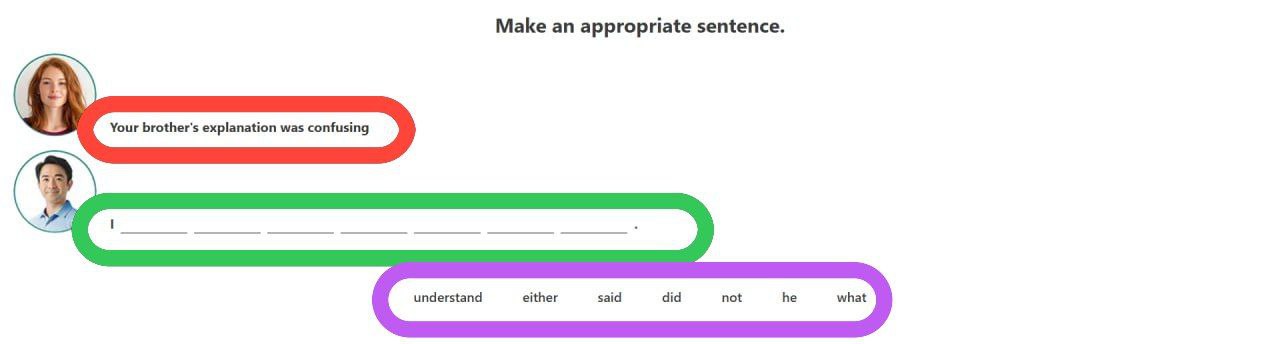
As you can see, these questions include a prompt sentence (the red box), an incomplete sentence with several blanks (the green box), and a number of mixed words or phrases (the purple box). Your task is to place each word into the correct blank to complete the sentence properly.
You do not type the words into the blanks with your tiny squirrel paws. Instead, you drag and drop each word into the position you want. If you accidentally place a word in the wrong blank and want to remove it, simply click on that word again to deselect it.
Both the prompt sentence and the sentence you need to build can be either statements or questions. In the example above, both sentences were statements. In the example below, the prompt sentence is a question while the sentence you need to build is a statement.
Make an appropriate sentence.

Why did the client call this morning?

{They} {want} {an update} {on} {when} {we} {expect} {the project} {to finish}.
And in the next example, the prompt sentence is a statement while the sentence you need to build is a question.

Paying attention to the type of sentence is extremely important if you want to build the correct answer and collect all those tasty TOEFL points.
In some cases, the number of word chunks provided is exactly the same as the number of blanks. In that situation, your only job is to arrange them in the correct order. For example, in the following question, there are seven blanks and exactly seven word chunks to complete the sentence.
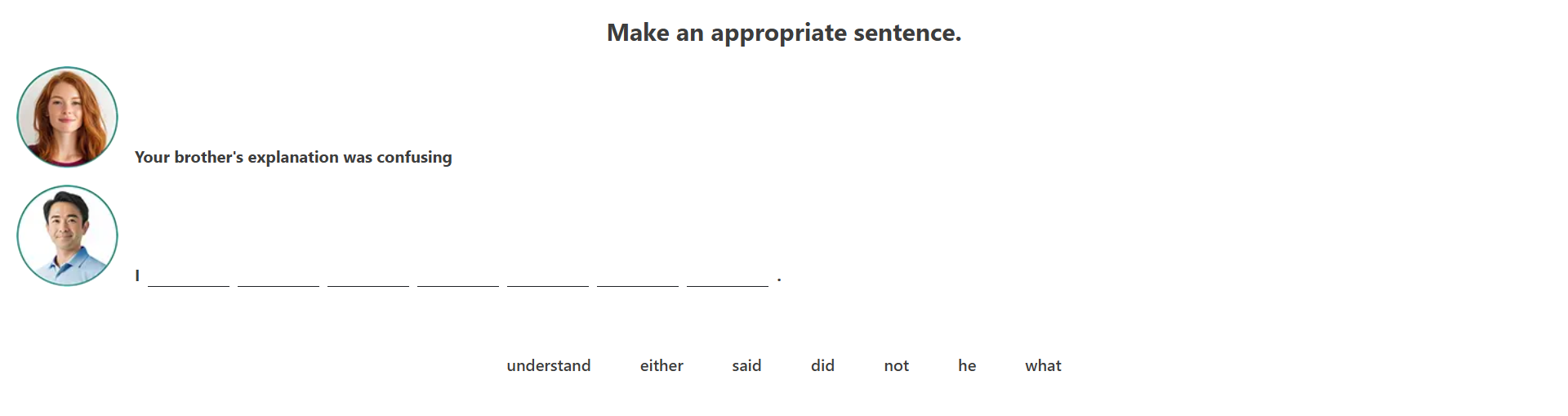
However, in the more common version of these questions, the number of word chunks is more than the number of blanks. In these cases, besides finding the correct word order, you also need to figure out which word or phrase is extra and should not be used. In TOEFL questions, these extra choices are usually not random little forest distractions — they are carefully designed to challenge you and can easily lead your squirrel brain to the wrong answer if you are not careful.

In this question, the words are carefully chosen so that, at first glance, all of them look correct and tempting to use. Sneaky little acorns, aren’t they? 🐿️ For example, seeing like together with did and what may push you toward building a direct-question structure like this:
Can you tell me what did you not like about it?
However, after Can you tell me, the sentence must follow statement word order, not question word order. If you do not fully understand this structure and instead depend only on the meanings of the words or translate the sentence too directly from your own language, you will probably choose the wrong answer.
The correct sentence is:
Can you tell me what you did not like about it?
In this task, you may see anywhere from 9 to 12 questions, and you usually have about 6 to 8 minutes to complete them. That means you should spend around 45 seconds on each question on average. So if you want to avoid wasting precious test time, having the right strategy is extremely important.
As you saw, the sentence you need to build already includes one or more guide words placed in the sentence beforehand. Think of these words as little paw prints showing you the path! They help you complete the rest of the sentence correctly.
One of the biggest mistakes test takers make in this task is trying every word in every blank without any clear strategy or plan, simply hoping that a logical sentence will magically appear. Not only does this take a huge amount of time, but it also greatly increases the chance of making mistakes.
Strategy for Answering TOEFL Writing Task 1 Questions: Understanding Movable and Fixed Parts of Sentences
In English, sentences are built from phrases, not individual words. That means you should not try to build sentences one word at a time like a squirrel dropping random nuts into a pile. Instead, you should think in terms of phrases and sentence structures.
Once you become familiar with these structures and fixed phrases, you will start recognizing them immediately whenever you see the words. Rather than thinking about each word separately and placing them into the blanks one by one, you will be able to move entire structures together as one unit. This saves time and greatly reduces errors.
We call these structures the skeleton of the sentence. Once the sentence skeleton is in place, adding the remaining parts becomes much easier.
Types of Phrases
- Noun Phrases
- Verb Phrases
- Prepositional Phrases
When facing these questions, your first step should be to identify these phrases among the given words. Then, you should place the phrases into the sentence in the correct order.
Noun Phrases
In noun phrases, there is one simple rule: a noun phrase is built around a noun, and every other word in the phrase exists only to make that noun more complete or more specific.
The typical structure of a noun phrase is:
#green Determiner #green + #orange adjective #orange + #red noun #red
For example:
- #green the #green #red book #red
- #green a #green #orange new #orange #red chair #red
- #green many #green #orange international #orange #red teachers #red
You cannot change this structure. For example, you cannot say new a chair or students many international. So whenever these words appear together, they travel together like a tidy little squirrel family and always keep the same order.
If a number is included, the structure usually becomes:
#green Determiner #green + #purple number #purple + #orange adjective #orange + #red noun #red
For example:
- #green the #green #purple two #purple #red students #red
- #purple five #purple #orange international #orange #red teachers #red
Determiners are words that come before nouns and help define reference, quantity, ownership, or how specific the noun is. In general, determiners fall into several main categories:
- Articles such as a / an and the, which show whether a noun is specific or non-specific (a problem vs. the problem)
- Possessives such as my, your, and their, which show ownership (my project)
- Demonstratives such as this, that, these, and those, which point to specific people or things (these examples)
- Quantifiers such as some, many, much, and several, which show quantity or amount (many students, some information)
In all of these cases, the determiner always comes before the noun and helps the reader understand exactly which noun is being discussed.
Degree adverbs can also appear inside noun phrases. These adverbs express the intensity or degree of adjectives, so they must come before the adjective within the noun phrase.
For example:
- a very important class
- an extremely difficult subject
- a highly effective solution
| Common / Neutral | Strong / Academic |
|---|---|
| very | extremely |
| quite | highly |
| rather | significantly |
| fairly | substantially |
| somewhat | considerably |
| slightly | remarkably |
| almost | exceptionally |
| nearly | severely |
| too | dramatically |
| enough | increasingly |
Question: If several adjectives describe the same noun, what order should they follow?
Answer: In English, adjectives follow specific ordering rules. But for TOEFL questions, learning this simple pattern is usually enough to help you solve most Build a Sentence tasks. Arrange adjectives in this order: opinion + type + noun
Opinion adjectives express the speaker’s opinion, judgment, or attitude toward something. In other words, they show what you think about the noun.
Examples: valuable, beneficial, debatable, practical
Type adjectives describe the category, field, or nature of something. They explain what area or type the noun belongs to.
Examples: scientific, cultural, economic, technological
Correct Examples:
- a useful academic resource
- an effective educational policy
- a controversial scientific theory
- a practical technological solution
Incorrect Examples:
- an academic useful resource
- an educational effective policy
- a scientific controversial theory
- a technological practical solution
Let’s wrap up everything we learnt from the points above:
A correct noun phrase usually follows this structure:
Determiner + number + degree adverb + adjective + noun
For example:
- These two highly effective strategies
- Those three extremely complex theories
- The five significantly improved results
Now it's your turn! Let's practice!
Build a noun phrase from the scrambled words below:
research / extremely / the / three / complex / completed / researchers / have
Correct noun phrase:
the three extremely complex research projects
Could you get it correctly? Let's try another one!
policy / new / the / government / three / highly / effective / announced / has
Correct noun phrase:
the three highly effective new policies
In TOEFL Build a Sentence tasks, some of the given words naturally form a noun phrase when placed together. This phrase usually includes a noun along with words such as articles, numbers, degree adverbs, or adjectives that all work together to describe that noun.
In these questions, such words should be treated as one complete unit and should not be separated. If you can recognize these groups of words as a single phrase, building the correct sentence becomes much easier and the chance of making mistakes drops greatly.
Even if the verb or the overall sentence structure changes, the noun phrase itself should stay together. For this type of question, the best strategy is to first identify the main noun, then attach all the words that describe it, and finally place the entire phrase into the sentence as one unit. Following this approach helps you keep the correct word order and avoid common mistakes.
Verb Phrases
A verb phrase shows what happens or what action is performed in a sentence. In fact, the core meaning of the sentence usually lives inside the verb phrase, and without it, the sentence feels incomplete, like a squirrel trying to run without its tiny paws! 🐾
A verb phrase generally follows this structure:
Auxiliary Verb + Main Verb + (Object / Complement)
In some sentences, there may be no auxiliary verb, but the main verb is always there.
Examples:
- will influence academic results
- has increased student motivation
- can improve writing accuracy
In each of these examples, several words work together to form one verb unit, and they should not be separated.
Rules of Verb Phrases
Rule 1: Auxiliary verbs always come before the main verb
Common auxiliary verbs include:
be, am, is, are, was, were, being, been
have, has, had
do, does, did
will, would, can, could, may, might, should, must, shall
Examples:
- will increase
- has improved
- is affecting
Rule 2: Degree adverbs and frequency adverbs usually come between the auxiliary verb and the main verb
Common TOEFL adverbs of this type include:
significantly, substantially, frequently, often, already
Examples:
- Students have often complained about deadlines
- The results are significantly affected by stress
Look at the following sentence:
This number has increased significantly.
As you can see, the adverb comes after the main verb in this sentence. Grammatically, this structure is correct. However, in TOEFL Build a Sentence tasks, ETS usually prefers the pattern:
Auxiliary + Adverb + Main Verb
So in most TOEFL questions, following this structure will help you build the correct sentence more easily and keep your squirrel brain from getting tangled in the branches.
Rule 3: The object always comes after the main verb
The object is the part of the sentence that directly receives the action of the verb. It tells us “what” or “who” is affected by the action, which is why its natural position is after the main verb.
Examples:
- require data
- affect people
Rule 4: There is only one main verb in a verb phrase
A verb phrase may contain one or more auxiliary verbs, but it always has only one main verb.
Correct Examples
(the main verb is in bold)
- will consider
- has been developing
- should have thought
Incorrect Examples:
- will affect improve
- has improved increase
Rule 5: Modal verbs are strong signals for the start of a verb phrase
If you notice a modal verb among the given words, your job becomes much easier because you can quickly build a verb phrase around it , just like spotting a trail of hazelnuts in the forest. 🌰
The most common modal verbs are:
can, could, may, might, must, should, will, would
Examples:
- can improve performance
- should reduce costs
So whenever you see these verbs, immediately start building the verb phrase from that point.
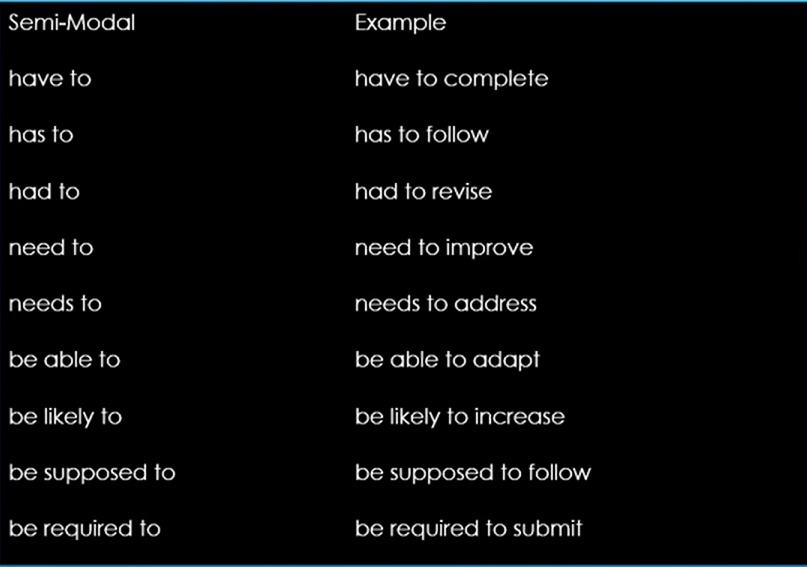
Semi-modal verbs
Semi-modal verbs are similar to modal verbs in meaning, but they usually appear as multi-word structures and are followed by to + base verb, such as:
- have to complete
- be able to adapt
Unlike regular modal verbs such as can or should, semi-modals can change form depending on the tense or subject. For example:
- have to
- has to
- had to
In TOEFL Build a Sentence tasks, these structures are important because ETS treats them as one complete verb phrase. For this reason, their parts should never be separated and should always stay together. If you can recognize these combinations quickly, building the verb phrase — and the entire sentence — becomes much easier.
Common Semi-Modal Structures in TOEFL Questions
In more difficult and advanced TOEFL questions, when a modal verb such as may, must, or could appears, it does not always end with a simple verb. Instead, it may combine with have or be to create a longer and more precise verb phrase that expresses time, certainty, or grammatical aspect.
If you can recognize these patterns quickly, you can easily spot the core verb structure and avoid putting the sentence together in the wrong order, a very helpful trick for busy little squirrel brains! 🐿️
Three common patterns are:
1. modal + have + past participle
Example:
may have influenced
2. modal + be + past participle
Example:
must be completed
3. modal + have been + V-ing
Example:
could have been increasing
Now let’s gather all the acorns we’ve collected so far and review everything together. In the scrambled words below, first identify the noun phrases (NP) and verb phrases (VP), then use them to build the sentence.
Example 1
highly / the / effective / three / strategies / significantly / have / improved / results
Noun Phrase:
the three highly effective strategies
Verb Phrase:
have significantly improved results
Now, instead of arranging each word separately, you simply place these larger phrases together like neat little stacks of nuts.
Final Sentence:
The three highly effective strategies have significantly improved results.
Example 2
those / three / highly / controversial / scientific / theories / might / significantly / influence / research
Noun Phrase:
those three highly controversial scientific theories
Verb Phrase:
might significantly influence research
Final Sentence:
Those three highly controversial scientific theories might significantly influence research.
Prepositional Phrases (PP)
A prepositional phrase adds extra information to a sentence, such as place, time, purpose, or context, but it does not create the main structure of the sentence itself. In simple terms, a PP makes the sentence more detailed and complete rather than forming its core meaning.
The basic structure of a prepositional phrase is:
Preposition + noun or noun phrase (NP)
Examples:
- for students
- in higher education
- at the end of the semester
Here’s an important little TOEFL acorn to remember: prepositional phrases usually come after the main sentence structure. In Build a Sentence tasks, you should recognize them as supporting elements. In other words, first build the noun phrases and verb phrases, and then attach the PP afterward.
Common Types of Prepositions
| Time | Place / Location | Cause, Purpose & Other |
|---|---|---|
| at | in | for |
| on | on | of |
| during | at | with |
| before | near | by |
| after | under | about |
| while | over | from |
| throughout | between | due to |
| within | among | because of |
| by | inside | according to |
| since | outside | despite |
Most sentences in TOEFL Writing Task 1 Build a Sentence questions generally follow this structure:
NP + VP + NP + PP
Example:
- the new rule → NP
- will affect → VP
- many candidates → NP
- in higher education → PP
Now let’s build the following sentences using this strategy.
regulation / has / impacted / directly / the / funding / research / in / universities / new
Phrase Analysis:
- the new regulation → NP
- has directly impacted → VP
- research funding → NP
- in universities → PP
Final Sentence:
The new regulation has directly impacted research funding in universities.
investment / has / improved / significantly / transportation / public / in / areas / government / urban
Phrase Analysis:
- government investment → NP
- has significantly improved → VP
- public transportation → NP
- in urban areas → PP
Final Sentence:
Government investment has significantly improved public transportation in urban areas.
technology / has / reduced / gradually / consumption / energy / in / buildings / advanced / modern
Phrase Analysis:
- advanced technology → NP
- has gradually reduced → VP
- energy consumption → NP
- in modern buildings → PP
Final Sentence:
Advanced technology has gradually reduced energy consumption in modern buildings.
Common TOEFL Traps
Trap 1: WH-Questions with Auxiliary Verbs vs. WH-Words Acting as the Subject
These two question types are one of the biggest squirrel traps in TOEFL Build a Sentence tasks. 🐿️ Being able to tell the difference between them is extremely important.
WH-Questions with Auxiliary Verbs
In this type of question, the auxiliary verb must come before the subject after the WH-word.
Pattern:
WH + auxiliary + subject + base verb … ?
Correct Example:
Why did the meeting end early?
Incorrect Example:
Why the meeting ended early?
When the WH-Word Itself Is the Subject
If the WH-word itself functions as the subject of the sentence, you no longer need an auxiliary verb. The main verb comes directly after the WH-phrase. Adding an auxiliary verb in this case is incorrect.
Pattern:
WH + noun + main verb … ?
Correct Example:
Which factor influences student motivation?
Incorrect Example:
Which factor does influence student motivation? ❌
(does should not be used here.)
Question: How can I tell the difference?
Answer: In TOEFL Build a Sentence tasks, whenever you see a WH-question, the very first thing you should check is whether the WH-word itself is acting as the subject. ETS absolutely loves using this tiny grammar acorn to confuse test takers.
If there is a separate subject among the given words together with the WH-word, then the WH-word is not the subject. In that case, you must use an auxiliary verb before the subject.
For example, if the words are:
why / did / students / choose / this method
the presence of students shows that the WH-word is not the subject, so the correct structure must include did.
However, if there is no separate subject after the WH-word, and the WH-word is attached directly to a noun phrase such as which factor or what change, then that phrase itself functions as the subject. In this situation, you should not look for an auxiliary verb, and the sentence should be built directly with the main verb.
ETS often includes an extra auxiliary verb on purpose to trick you, but in this type of question, that auxiliary should not be used at all. Sneaky little trap, huh? 🌰
which / factor / most / strongly / affects / academic / performance / does
Correct Answer:
Which factor most strongly affects academic performance?
As you can see, there is no need for an auxiliary verb, even though does was included among the given words to mislead you.
Trap 2: Indirect / Embedded Questions
In indirect questions, the sentence follows statement word order, not direct-question structure.
In indirect questions, the structure works a little differently from direct questions. First, there is a main clause, and then an additional clause introduced by words such as if or whether.
The general pattern is:
Main clause + if / whether + subject + verb
The important point is that after if or whether, you should no longer invert the subject and verb the way you do in direct questions. The word order must stay in normal statement form.
Examples:
- Do you know if she will be moving?
- Can you tell me whether the cabins will be available?
In both sentences, the part after if or whether follows normal statement order: subject + verb.
The incorrect form would be:
whether will the cabins be available
How Can You Recognize Them?
Rule:
If words such as if, whether, what, where, when, why, or how appear after verbs like know, ask, wonder, tell, or explain, the clause that follows uses statement word order, not question inversion.
Example 1
Direct Question (with inversion):
Where is she going?
Indirect Question (without inversion):
Do you know where she is going?
❌ Do you know where is she going?
Example 2
Direct Question:
Why did he leave early?
Indirect Question:
I wonder why he left early.
❌ I wonder why did he leave early.
Example 3
Direct Question:
What time does the meeting start?
Indirect Question:
Can you tell me what time the meeting starts?
❌ Can you tell me what time does the meeting start?
Example 4 (with if / whether)
Direct Question:
Is she coming?
Indirect Question:
I don’t know if she is coming.
❌ I don’t know if is she coming.
TOEFL Writing Task 1 Answering Tips
1. Before arranging the words, carefully read the prompt or situation
As we mentioned earlier, every Build a Sentence question is presented as part of a short conversation or situation.
If the given sentence is a question, you will usually need to build a statement in response.
If the sentence is a statement, your answer may take the form of confirmation, explanation, or completion of the idea.
So before doing anything else, pause for one tiny squirrel second and decide this:
Am I supposed to build a question or a statement?
This simple decision determines whether you need inversion or not.
2. Be careful with inversion traps
This is one of the most common reasons test takers lose points.
In direct questions, the subject and auxiliary verb switch places:
What time does it start?
But in indirect questions, the sentence keeps normal statement order:
Do you know what time it starts?
Practice this pattern carefully until recognizing it becomes automatic, like a squirrel spotting hidden hazelnuts from far away. 🐾
3. First look for structures (the sentence skeleton)
As explained earlier, identifying phrase structures and placing them into the sentence as complete units, instead of choosing words one by one, saves time and greatly reduces mistakes.
4. Use grammar rules to eliminate extra options
When there are more word chunks than blanks, the extra words are usually placed there intentionally to confuse you.
Here are a few simple ways to eliminate incorrect choices:
- Subject–Verb Agreement
If the subject is plural, eliminate singular verbs.
- Remove unnecessary repetition in relative clauses
In sentences with words such as who, which, that, or where, these words already function as the subject or object of the relative clause. Because of that, you usually do not need an additional pronoun like it, them, he, or she.
Correct:
The book that I bought was expensive.
Incorrect:
The book that I bought it was expensive.
In the second sentence, it is unnecessary and incorrect because that already functions as the object.
So if you see an extra pronoun after who / which / that / where, it is probably a distractor that should be removed.
- Watch for incorrect collocations
In English, some words naturally travel together and form common combinations called collocations. If you know these combinations, you can quickly spot unnatural choices and toss them aside like empty walnut shells.
We say:
- make a decision (not do a decision)
- meet the deadline (not reach the deadline in most formal situations)
- take a risk (not do a risk)
So if one of the options does not match a natural collocation, it is probably a distractor.
5. Do a quick final check before submitting
Before submitting each answer, quickly ask yourself:
- Does the verb match the subject?
- Is the word order correct for a statement or question?
- Is any necessary part missing?
Do not become overly perfectionistic. If the sentence is grammatically correct and logically clear, submit it and move on before the TOEFL timer scampers away with your precious minutes! 🐿️
A Nutty Farewell
That’s All, Folks!
Now you know everything you need to go through Toefl Writing Task 1!
Make sure to practice all the tips and don’t forget to ask if you have any further questions!